The Warehouse with the Mystery Drip
A logistics company on the south side of Honey Creek called us after their third bucket appeared under the same roof joist. Their maintenance guy had already climbed up twice with a tube of black roof cement and smeared it across what he thought was the leak. The drip kept coming. When we arrived, we did what he had not done: we started at the drain and worked outward, because water on EPDM rarely enters where it exits.
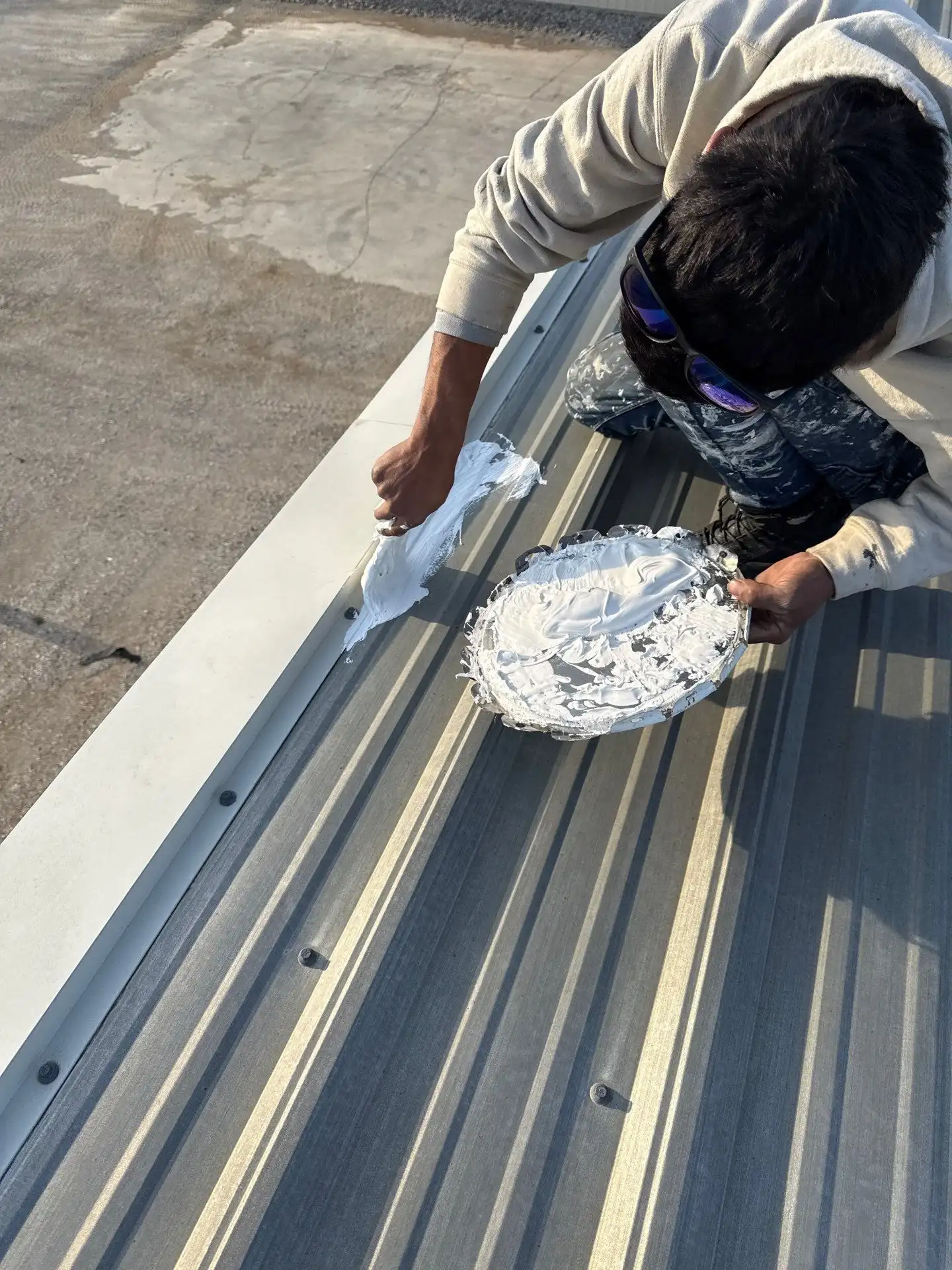
Our moisture meter readings climbed steadily as we walked north, peaking 28 feet away from the interior drip. The actual entry point was a hairline split at a T-joint seam where three sheets met behind a rooftop unit. Water was traveling between the membrane and the insulation board, finding a fastener penetration, and dropping straight down. We cleaned the area, primed it, and installed a 12-inch EPDM cover strip with seam tape and lap sealant. Total repair cost came in around $850. The bucket has been dry for two years. For broader context on this kind of detective work, our guide to roof leak origin detection versus repair walks through why the visible drip almost never marks the real failure.
What made this call typical was the maintenance history. The black cement smears we found on the roof were not failures of effort, they were failures of diagnosis. Asphalt based mastics actually harm EPDM over time, softening the rubber and accelerating the very seam separation the owner was trying to stop. We pulled three old patches off that roof before we left, and replaced each with proper EPDM-compatible materials. The maintenance guy watched the whole repair and asked good questions. He has since called us twice for second opinions before climbing back up himself.
The Medical Office and the Shrunken Membrane
An older single ply EPDM roof on a Honey Creek medical office had reached the age where the rubber itself was the problem. The membrane had shrunk over 16 years of thermal cycling, pulling the flashings away from the parapet walls by nearly an inch in some spots. The building owner wanted a repair quote, not a replacement, so we walked him through what we were seeing.
You cannot patch your way out of systemic shrinkage. We told him directly that spot repairs at the parapets would buy him maybe two seasons before the next failure popped up six feet over. He appreciated the honesty and we scoped a partial recover with new termination bars and fresh flashing membrane along all four perimeter walls. That job ran about $7,200 and bought him a realistic five to seven more years before full replacement. When interior damage had already started downstairs, we coordinated with our ceiling water damage repair team to handle the stained drywall in two exam rooms.
The Restaurant That Waited Too Long
A Honey Creek restaurant owner called us in February after a stretch of freeze thaw cycles. He had known about a soft spot near his rooftop grease exhaust for over a year. He kept meaning to get to it. When we cut a test square, the gypsum cover board underneath crumbled in our hands and the iso insulation below was black with mold. What started as a $600 seam repair had grown into a $4,400 deck section replacement.
His insurance covered some of the interior damage to the kitchen ceiling but not the roof work itself, because deferred maintenance is almost never a covered loss. We see this pattern repeatedly. The longer a small EPDM defect goes unaddressed, the more it costs to chase later. Grease exhaust areas are especially unforgiving because the surrounding membrane is already chemically stressed by airborne residue. If you are wondering what your policy actually covers when a roof leak floods a ceiling, our breakdown of what homeowners and commercial policies include is worth a read.
What EPDM Repairs Typically Cost in Honey Creek
Pricing depends on the failure type, access, and how much wet insulation has to come out. A single seam patch on an accessible flat roof usually lands between $450 and $900. Multiple seam repairs across a larger area, where we are pulling back ballast or working around equipment, run $1,200 to $2,500. Rebuilding flashings at parapets, curbs, or penetrations climbs into the $2,800 to $4,500 range depending on linear footage. Once wet insulation enters the picture and a partial recover becomes the right call, owners should plan for $6,500 to $12,000 on a typical Central Indiana commercial roof.
These ranges shift with roof access. A building with interior stair access and a parapet ladder costs less to work on than one requiring a boom lift in a tight parking lot. We always price the access honestly before we price the repair.
The HVAC Puncture Nobody Mentioned
One Honey Creek office park manager swore his roof had no leaks until the day a contractor finished a rooftop unit replacement. Within a week, a corner conference room had a wet ceiling. When we inspected, we found two screws driven straight through the EPDM where the new curb adapter had been bolted down. The HVAC crew never said a word about it.
This story is worth telling because it happens often. Anyone walking your rubber roof, satellite installers, HVAC techs, painters, can leave behind punctures that take weeks to show. The fix itself was simple: clean, prime, patch with a 6-inch EPDM target patch and lap sealant, about $400 total. The harder part was the conversation with the property manager about who pays. We now recommend our commercial clients require a roof condition photo before and after any trade walks their membrane. It takes ten minutes and settles disputes before they start.
How Our Crews Approach a Rubber Roof Call
- Severity is assessed over the phone, and inspections are scheduled fast.
- For active leaks, we prioritize tarping and temporary dry in before chasing the root cause.
- We trace water from the interior drip back across the membrane, not from the stain straight up.
- We give you photos of every defect we find, not just the one you called about.
- If we cannot help, we will tell you directly.
The Self-Storage Facility and the Ponding Problem
A self storage operator outside Honey Creek called about staining on the ceiling of three units in the same row. The EPDM looked intact when we got up there, but a 40 foot stretch of roof held standing water two days after the last rain. Ponding alone does not cause leaks on a sound membrane, but it magnifies every weakness. We found three pinholes within the ponded area, each less than a millimeter wide, invisible from a standing position.
We patched the pinholes, then talked through the bigger issue with the owner. The deck had sagged slightly between joists, and no patch program would fix the drainage. He ended up adding two new roof drains the following spring, which solved the ponding and dropped his repair call frequency to nearly zero.